Friday, March 28, 2014

China Housing Bubble Blues

At least for one Chinese real estate developer, Zhejiang Xingrun Real Estate, the party is over.  I'm not sure what to make of the company's demise but I think this might be a bigger issue than the Chaori bankruptcy.  The Chinese real-estate market is surely larger than the solar energy market, with greater asset values and greater liabilities.  From the Sydney Morning Herald:
A Chinese real estate developer with more than half a billion dollars in debt has collapsed and its largest shareholder detained in what could be a further sign of financial stress in the world's second largest economy. 
The Zhejiang Xingrun Real Estate Co, which is based in wealthier eastern China, did not have sufficient cash to repay 3.5 billion yuan ($625 million) of debt to creditors, including more than 15 banks, Chinese officials reportedly told local and international media. 
The collapse of the company, based in the eastern town of Fenghua, has put investors on edge as it adds to concern of strains in the nation's real estate sector and comes less than two weeks after the first bond default by a Chinese company.

Wednesday, March 26, 2014

Oil Industry Austerity

Despite a projected record year for capex spending in 2014, oil majors are doing their best to reign in their spending (see ExxonMobil for a specific case).  This fiscal restraint will likely hit off-shore rig manufacturers who have no-contract new builds, service companies, and the employees of the various respective oil companies.

Non-majors have been experiencing the pinch from rising labor and completions costs.  EnCana late last year announced a 20% reductions in its workforce; UK firm BG Group may be reducing its workforce by more than 5%; Chesapeake late last year announced that the punch bowl would be taken away under new CEO Doug Lawler.

The money quote came at IHS CERAWeek 2014 from Chevron's CEO, John Watson:
$100 oil is becoming the new $20 oil.

China: Top Net Oil and Petroleum Products Importer

From the EIA:
In September 2013, China's net imports of petroleum and other liquids exceeded those of the United States on a monthly basis, making it the largest net importer of crude oil and other liquids in the world. The rise in China's net imports of petroleum and other liquids is driven by steady economic growth, with rapidly rising Chinese petroleum demand outpacing production growth.

Thursday, March 20, 2014

Buy, Sell and Trade: Repo

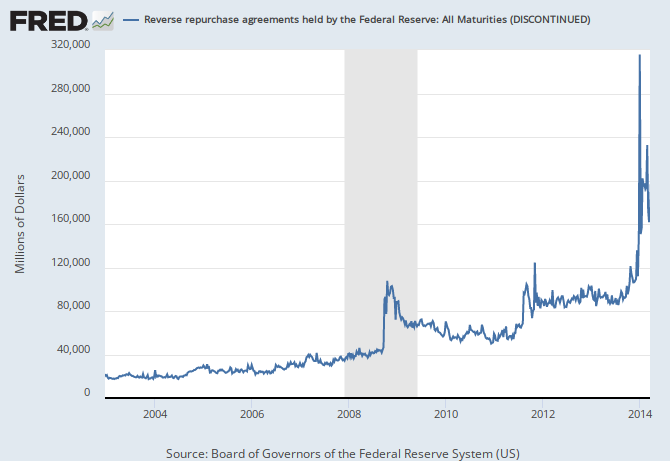
The Federal Reserve tapering has included a substantial increase in reverse repo activity.  The Fede really needs the cash, right?

Reverse repos held by the Federal Reserve.


Reverse repurchase agreements are transactions in which securities are sold to primary dealers or foreign central banks under an agreement to buy them back from the same party on a specified date at the same price plus interest. Reverse repurchase agreements absorb reserve balances from the banking system for the length of the agreement. They are typically collateralized using Treasury bills. As with repurchase agreements, the naming convention used here reflects the transaction from the dealers' perspective; the Federal Reserve receives cash in a reverse repurchase agreement and provides collateral to the dealers.

Ticker-Taper Parade

For the third time in four months, the Federal Reserve has trimmed $10 billion in asset purchases: 12/18/14, 1/29/14, and 3/19/14.  And here is the rise in short-term interest rate:

1-year treasury (blue) and the Fed Funds (red) rate.

Percent change from year ago in Federal Reserve holdings.

Tuesday, March 18, 2014

2014 Global Oil Exploration and Production Spending

Global oil exploration and production (E&P) spending is expected to reach $723 billion in 2014, according a Barclays report published in December 2013.  Putting the 2013 number ($682 billion)  in perspective of gross world product (GWP) means it would have accounted for 0.95% of gross world product (CIA data) for 2013.

Taking it one step further, using the IMF's estimated 2014 GWP growth rate of 3.7%, the estimated $723 billion in spending would account for 0.97% of 2014's GWP.  The quick and dirty method may not be the best way to come to such a conclusion.