Wednesday, December 3, 2014

Bring 'Em Out: Rise of the Consumer

So, I do not read Business Insider. Which is why I chose to use one of their headlines as a contrast for my thesis of rising consumer spending.


Black Friday sales plummeted this year, leaving retailers completely stumped.  
After weeks of declining gas prices, many analysts predicted the biggest holiday season ever. Industry groups like the National Retail Federation reasoned that Americans would use their fuel savings on gifts.  
Despite encouraging forecasts, Black Friday weekend sales were down 11%. Cyber Monday sales rose 8%, falling short of many predictions. 
So where are the customers?

Where are the customers at? Where they at?

The Lord Purveyor of Future Obligations, His Royal Roll-Over of Timely Payment,  Fortress of Accountability, Luke The Debtor saith: Buying higher ticket items.

That's just me. Maybe no one else feels that same way. But after 6 years of paying down debt, I wonder if this drop in oil prices is giving people the premature illusion of prosperity. But, the data are not in to show this. Where are the customers? It is time say Luke The Debtor...bring 'em out!


Tuesday, November 18, 2014

Saturday, November 15, 2014

Looking at The Data: Top Three & Next Three Oil Producers

It's cold this weekend. Very cold. The arctic blast, polar vortex, Rossby wave or whatever you want to call it, is acting up. So, I am staying inside.

For all the commotion in the media not geared toward the weather or Ferguson, there has been some attention spent on Saudi Arabia's offer of higher prices for Asian consumers and lower prices for others.  This is all before the G-20 and the OPEC meetings this month.  Maybe the Saudis want to remind everyone who is the alpha dog.

However, the US, the largest consumer is, according to the EIA (biased?), the largest producer of oil.  And its accent to number one has come within the past four years.  This is must be a testament to American ingenuity, low-interest rate induced prices, and the inability to exit (escape) the exurban lifestyle.


Saturday, November 1, 2014

There's a New Dealer at the Table

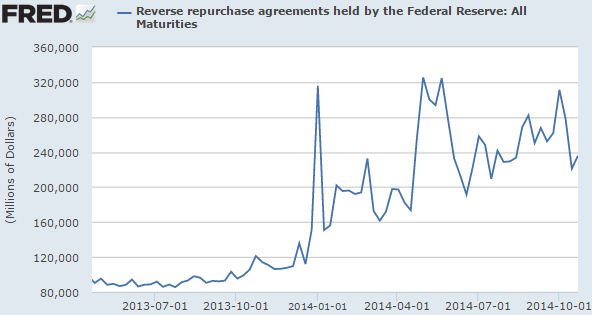
A weekend post, which means a lot of incoherent ranting and linking to someone else's post and commenting about it here on my blog. Awesome.  So here is Soberlook's post regarding the halt in the Fed's monetary expansion and use of repo deals (reverse repos).

So, despite the end to the (in)famous QE3, the monetary base had already begun to peak.


There is a new dealer at the table - same as the old dealer. Even though the Fed is now reducing its QE purchases to the $15 billion dollar range, it will continue to stoke the markets as the dealer at the  repo table.  Maybe repos are the unconventional policy that the Fed needs.


Analogously, oil production in the US is turning unconventional - drilling sideways and shoving a bunch of sand and water down the hole.  It works.  It works very well.  So why shouldn't repo financing work for the Fed?  Well, some people claim that repo deals are what allowed banks to leverage themselves to the point of utter ruin (i.e. Lehman).

But just because Lehman can't get it right doesn't mean others can't.  I mean, just because BP and ExxonMobil struggle with their onshore tight oil and gas plays doesn't mean other companies will or have to struggle.

Wednesday, October 29, 2014

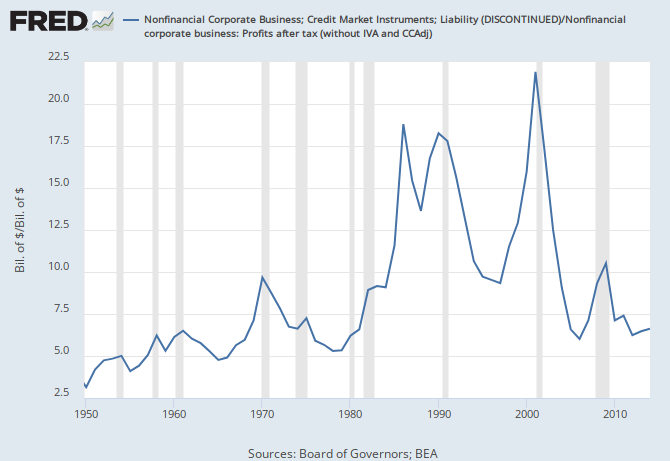
Standby For Corporate Debt Launch

Just my gut feeling telling me that the US corporate scene has room to grow.  See chart below.


Wednesday, October 8, 2014

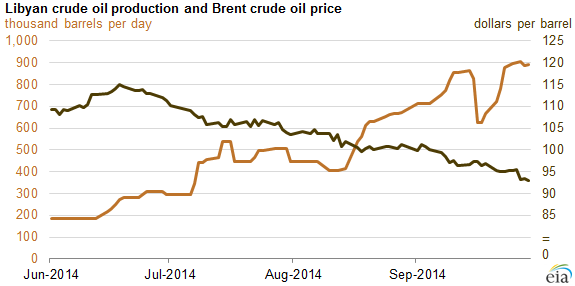
Libyan Oil Production: It's Back

Oil prices continue their slow downward descent as supply outpaces demand. One new contributing member to the supply increase is Libya's increased oil production.  My previous note on Libyan oil production noted a decline in production in the 2Q of 2013, though after a halt to production as rebels vied for control of Libya.


Wednesday, October 1, 2014

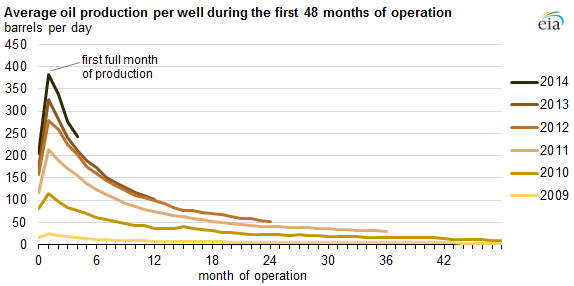
Eagle Ford: Fracking Revolution Seen in Chart

Unconventional techniques offer orders of magnitude more initial production (IP) than conventional techniques.  Looking at this chart from the EIA, it looks like IP is up by 400 times what it was just a few years ago and more than that before unconventional techniques.