Interesting article from Gizmodo about a (new) unoccupied 13-story apartment building which recently collapsed in China. The accident resulted in a single fatality. Of interest are the similar apartment buildings in the background.
I cannot really make out the foundation - perhaps that is it in the first photo. I cannot tell if the pylons, as seen from the fourth photo, are driven into the dirt or cemented into the foundation. It is a sad story. Though I am reminded of something Jim Chanos said in regards to the construction boom in China.
Venezuela and Iran both produce a heavy oil that is popular among Gulf of Mexico refiners in the US and refiners in China. As it stands with the current sanctions against Iran, Venezuela is probably getting a good deal out of the sanctions -- at least better than Iran. However, now that the US and Iran are approaching an agreement that could dissolve the economic sanctions, Venezuela has much to worry about. From Kejal Vyas at the Wall Street Journal:
CARACAS—Members of the Organization of the Petroleum Exporting Countries will have to accommodate any additional oil supply into the market in light of the recent easing of economic sanctions on Iran without changes to the cartel's overall production ceiling, Venezuela Oil Minister Rafael Ramirez said Thursday.
Mr. Ramirez said how Iranian crude is absorbed into the market will feature highly in discussions next week when OPEC members gather. Venezuela will push to maintain the group's 30-million-barrels-a-day quota, the minister said.
The U.S. and five other world powers reached an agreement on Sunday in Geneva to relieve some penalties on Iran in exchange for moves to cap the Islamic government's nuclear program.
"If this permits Iran to reach its maximum oil production, perfect. Then its production quota is guaranteed in OPEC, which must be respected, and we are going to back that [Iran's] normalization is respected," Mr. Ramirez said.
A massive power cut plunged the Venezuelan capital, Caracas, and other cities into darkness on Monday evening.
The Caracas metro ground to a halt and people had to be evacuated from shops and offices.
President Nicolas Maduro tweeted that the cut had been triggered in the same place as an outage in September, and suggested "sabotage" was responsible.
Power cuts are common in Venezuela, especially in the inland states, but rarely affect the capital.
Although Venezuela has large oil reserves it is dependent on hydro-electricity for about 70% of its power.
The blackout took place shortly after 20:00 on Monday (00:30 GMT Tuesday) as President Maduro was addressing the nation on television.
Blackouts in September were blamed on a vast right-wing conspiracy to sabotage the electrical system. Oil refineries were not effected by either blackout; instead those effected were households and small businesses in the capital city - a rare event. With his recently granted power to rule by decree for the next years, Nicolas Maduro may be grasping at straws.
First, the story of the toilet paper shortage. CNN article by Marilia Brochetto and Greg Botelho:
On Saturday, Vice President Jorge Arreaza announced the "temporary occupation" of the Paper Manufacturing Company's plant in the state of Aragua. The aim, he explained, is to review the "production, marketing and distribution (of) toilet paper."
"The ... People's Defense from the Economy will not allow hoarding or failures in the production and distribution of essential commodities," the vice president said.
By the "People's Defense," Arreaza was referring to a government agency created on September 13 by President Nicolas Maduro to "defeat the economic war that has been declared in the country," according to a report from state-run ATV. This group is charged with looking at inefficiencies across various industries in the nation, including foods and other products, and taking action presumably in the South American nation's best interests.
Toilet paper is very much a part of the war.
Now comes a more recent story of government sponsored looting of electronic stores. The Guardian article by Virginia Lopez:
"Living here is like a cartoon," Becerra says. "Most of us can't find milk to drink, let alone to produce, and the president's best plan is to lower the prices of TVs."
She was referring to president Nicolás Maduro's recent moves to get shopkeepers to slash their prices. Maduro has spoken of jailing retailers, criticising the "speculation and usury" that he blames for Venezuela's economic woes.
But concerns are mounting that his actions are just treating the symptoms, not the causes of Venezuela's sudden financial lurch, and that although it might give his citizens a nice cheap early Christmas, the new year hangover threatens to be painful.
Toilet paper factories taken over by the government. But the currency is still good?
You cannot buy milk but you can buy a fridge to store it in.
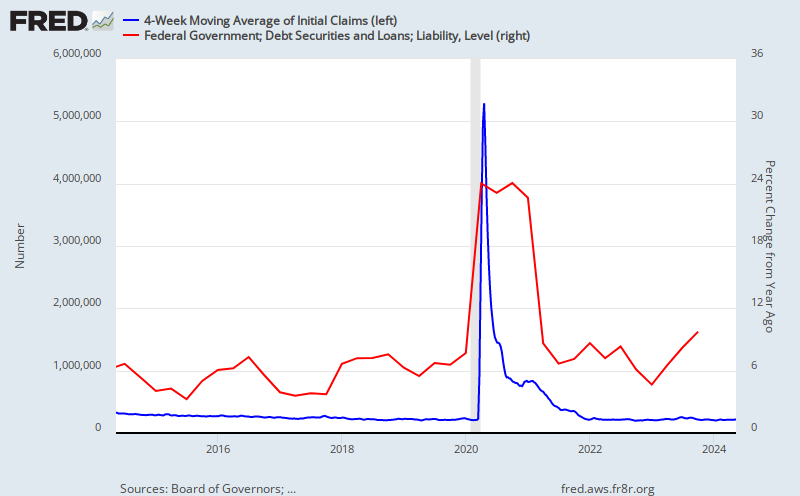
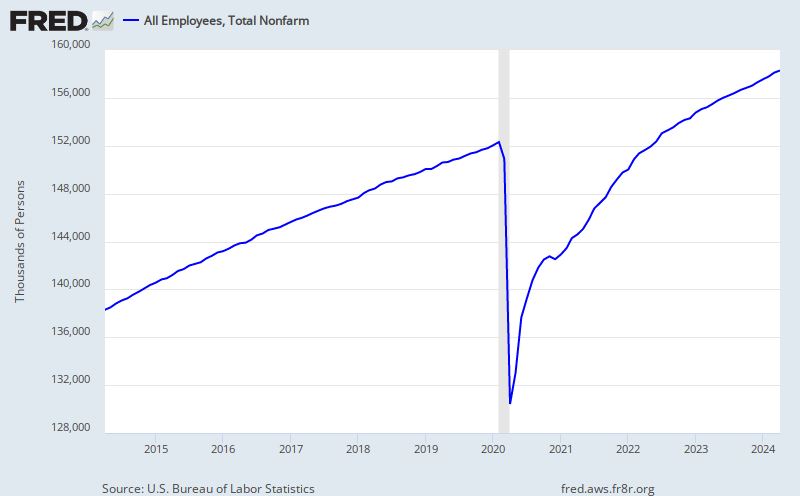
As the number of people on unemployment insurance declines, federal government expenditures will decline. Increasing payrolls will increase federal government income tax revenue. Will these two trends lead to a decline in federal debt in 2014?
4-week moving average of initial claims (blue; left) and federal debt (red; right).
Total non-farm payroll employment.
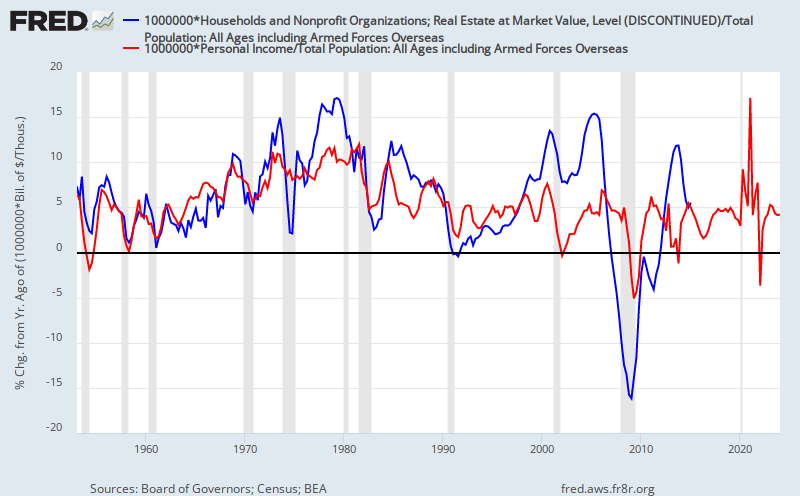
However, stagnant wages and a smaller worker to retiree ratio may depress federal tax revenue and increase the level of debt needed to finance entitlement spending -- especially Medicare and Medicaid. This could also cause real-estate prices to stagnate, which in turn could depress state and local tax revenue. Though, the lower demand (for stuff) due to stagnant wages and a larger (less active) retiree population could have a kind of cancelling effect.
Medicaid (W729RC1A027NBEA) and Medicare (W824RC1A027NBEA) as percent GDP.
Year-over-year change: household real-estate assets per capita (blue); personal income per capita (red).
Coal will surpass oil as the world's dominant fuel by 2018, and the mainland will be the dominant contributor to the development, an energy consultancy said.
The prediction highlights the difficulty to rein in reliance on pollution-prone coal, given its relative abundance and economic attractiveness.
"China and India's aggressive power requirements will be responsible for coal's burgeoning role in energy, but the United States, Europe and [the rest of] Asia will still contribute to coal demand," said London-based Wood Mackenzie's president of global markets William Durbin at the sidelines of the World Energy Congress.
Driven by urbanisation and industrialisation, "China's demand for coal will almost single-handedly propel the growth of coal as the dominant global fuel", he added.
Coal is China's primary energy source. Coal consumption has more than doubled since 2002. Oil and natural gas have also more than doubled in the same time but do not come near the same level of energy production as coal.
Chinese fossil fuel consumption from 1965-2012.
China accounts for roughly 50% of the world's annual coal consumption, and is both the largest producer and importer of coal. Indonesia, Australia and the US are some of China's biggest sources of imports. Chinese coal production mainly comes from northern states such as Inner Mongolia and Shanxi. China has roughly 12.6% of the world's proved coal reserves.
World coal proved reserves by country (source: Wikipedia).
One thing I found absent from the SCMP article is any discussion about water scarcity. Water is required for washing coal of impurities before it is burnt, and water is needed for the turbines of the coal burning power plants.
Polluted air and polluted and scarce water are some of the side effects of such a large increase (acceleration) in coal consumption. One solution to China's apparent lack of water is the massive South-North transfer project. The project has lead to a migration of nearly half a million people - many of whom have been evicted and forced from their homes.
Switching power generation from older power plants to new power plants may help China deal with their environmental issues. Traditional coal plants use a conveyor system to deliver coal to the ignition source. Modern coal plants use a pulverizer to break the coal apart and then inject into the ignition source -- similar to carburetors and fuel injection found in automobiles.
Increase use of technology as well as imports of cleaner coal may mean that China's current rate of consumption may not be sustained.
Update on the recessionary PIIGS of Europe...or are they. Before the data, consider the Bloomberg story by Angeline Benoit:
Spain’s two-year recession ended in the third quarter, underpinning Prime Minister Mariano Rajoy’s bet that exports can reboot the euro region’s fourth-largest economy.
Gross domestic product rose 0.1 percent from the second quarter, when it declined 0.1 percent, the Madrid-based National Statistics Institute said today. That matched the Bank of Spain’s estimate on Oct. 23. Inflation (SPCPEUYY) in October was 0.1 percent, the least since 2009, INE said in a separate release.
Exports are the only growth driver left to Spain as Rajoy imposes the deepest budget cuts in its democratic history amid a 26 percent jobless rate. Rajoy has pledged to stabilize the government’s debt load by the end of his term in 2015. Spain’s debt ratio has more than doubled since the nation started fighting a recession in 2008.
“This is an important staging post in what will be a slow but steady recovery,” Timo del Carpio, London-based economist at RBC Capital Markets, wrote in a note today. “The latest data, including more recent survey indicators, suggest the pick-up in growth this quarter is not ephemeral.”
Here are the data for the PIIGS -- Portugal and Ireland have obviously declining unemployment rates.
Lower gasoline prices may be coming from a large supply of corn -- the main ingredient in ethanol -- and there may be some help from debate about the US's ethanol mandate.
5-year corn price history as of September 2013.
The US corn harvest is producing a large bumper crop. This has caused the corn price to fall to its current three year low. It does stand to reason that the past several years of high corn price has lead to large corn investments in states like Iowa, Nebraska, Illinois and Kansas.
Ethanol futures tumbled for a second day as the government said farmers accelerated the pace of the corn harvest.
Prices fell 1.6 percent after the Agriculture Department said 59 percent of a record corn crop was collected as of Oct. 27, up from 39 percent the previous week. The grain is the primary ingredient in U.S. ethanol. Production has jumped 15 percent from a record low in January, according the Energy Information Administration.
“The weather was good and it was a pretty hefty jump in harvest,” said Mike Blackford, a consultant at Intl FCStone in Des Moines, Iowa.
Denatured ethanol for November delivery fell 3 cents to $1.801 a gallon on the Chicago Board of Trade. Futures are down 18 percent this year.
Gasoline for November delivery sank 2.11 cents, or 0.8 percent, to $2.6098 a gallon on the New York Mercantile Exchange. The contract covers reformulated gasoline, made to be blended with ethanol before delivery to filling stations.
Ethanol’s discount to the motor fuel widened by 0.89 cent to 80.88 cents a gallon, the largest differential since Oct. 21.
Despite large harvest, with roughly 40% remaining for harvest, the EPA is considering a cutback in the ethanol mandate -- the Bush era policy requiring certain amounts of ethanol to be blend into gasoline to replace the environmentally hazardous oxygenator methyl tert-butyl ether. The EPA can scale back mandates due to low supply. Via Paul Ausick at 247WallSt:
Battered by a host of complaints from refiners and blenders, the U.S. Environmental Protection Agency (EPA) is reported to be considering a reduction to the amount of ethanol required to be blended with gasoline in 2014. If the proposed reduction is adopted, it would be a huge win for oil refiners and a nasty blow to ethanol producers and farmers.
The Energy Policy Act of 2007 mandates production and blending of 18.15 billion gallons of biofuels in the U.S. motor fuel supply for 2014. Of that total, 14.4 billion gallons must be corn-based ethanol. According to the draft proposal obtained by Bloomberg and not available on the EPA website, the total amount of required renewable biofuels would be cut to 15.21 billion gallons, of which 13 billion gallons would be corn-based ethanol.
The EPA has the authority under the 2007 law to scale back the mandated volumes in certain situations, including inadequate supply or economic hardship. According to the proposal, the EPA claims, “We interpret the term ‘inadequate domestic supply’ as it is used under the general waiver authority to include consideration of factors that affect consumption of renewable fuel.”
Ethanol is not the only demand for corn. Livestock depend on corn feed, and food processors depend on high-fructose corn syrup as a sugar substitute, for instance. However, oil may still be the biggest contributor to the recent decline in gasoline prices.