Saturday, November 1, 2014

There's a New Dealer at the Table

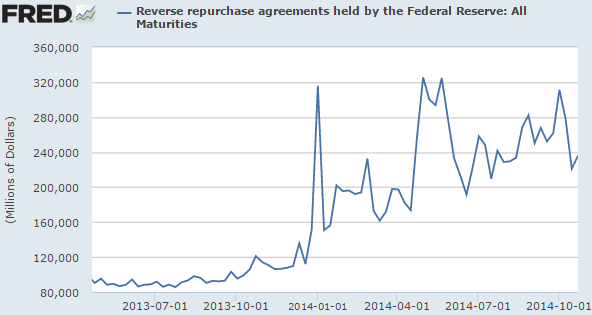
A weekend post, which means a lot of incoherent ranting and linking to someone else's post and commenting about it here on my blog. Awesome.  So here is Soberlook's post regarding the halt in the Fed's monetary expansion and use of repo deals (reverse repos).

So, despite the end to the (in)famous QE3, the monetary base had already begun to peak.


There is a new dealer at the table - same as the old dealer. Even though the Fed is now reducing its QE purchases to the $15 billion dollar range, it will continue to stoke the markets as the dealer at the  repo table.  Maybe repos are the unconventional policy that the Fed needs.


Analogously, oil production in the US is turning unconventional - drilling sideways and shoving a bunch of sand and water down the hole.  It works.  It works very well.  So why shouldn't repo financing work for the Fed?  Well, some people claim that repo deals are what allowed banks to leverage themselves to the point of utter ruin (i.e. Lehman).

But just because Lehman can't get it right doesn't mean others can't.  I mean, just because BP and ExxonMobil struggle with their onshore tight oil and gas plays doesn't mean other companies will or have to struggle.

Wednesday, October 29, 2014

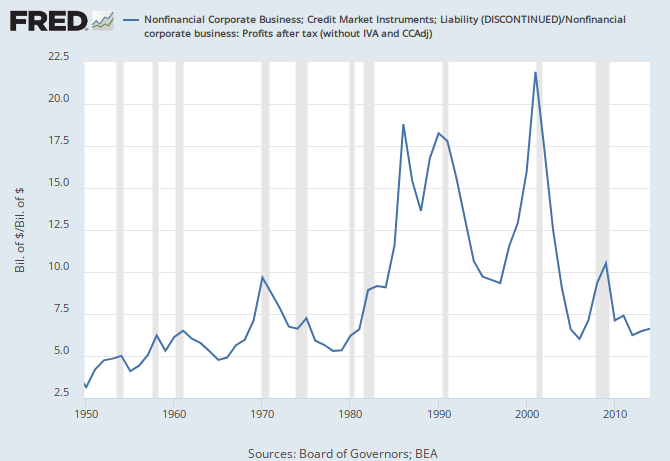
Standby For Corporate Debt Launch

Just my gut feeling telling me that the US corporate scene has room to grow.  See chart below.


Wednesday, October 8, 2014

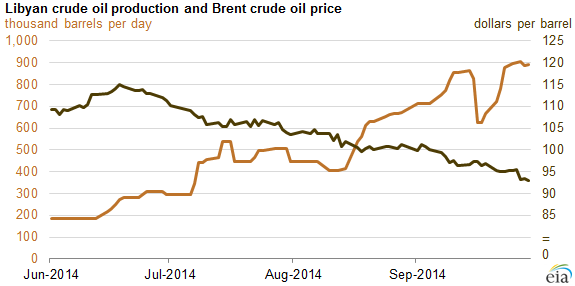
Libyan Oil Production: It's Back

Oil prices continue their slow downward descent as supply outpaces demand. One new contributing member to the supply increase is Libya's increased oil production.  My previous note on Libyan oil production noted a decline in production in the 2Q of 2013, though after a halt to production as rebels vied for control of Libya.


Wednesday, October 1, 2014

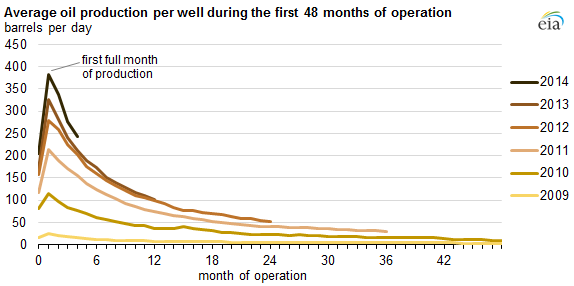
Eagle Ford: Fracking Revolution Seen in Chart

Unconventional techniques offer orders of magnitude more initial production (IP) than conventional techniques.  Looking at this chart from the EIA, it looks like IP is up by 400 times what it was just a few years ago and more than that before unconventional techniques.


Tuesday, September 23, 2014

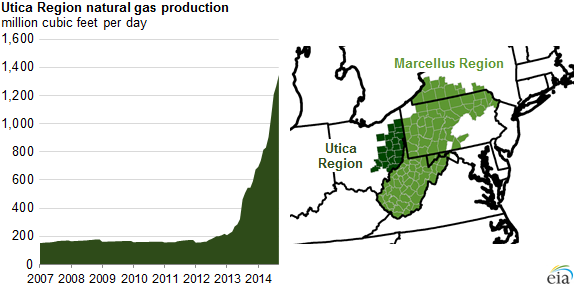
The Next Big Shale Formation And The Germans

The Utica is starting to blow up.  The last I checked, the rig count was below 50 but with Aubrey McClendon's new company, American Energy Group, looks like they are going all in on the Utica.  Other companies appear to be planning for large operations in the area such as Eclipse and Hess.  The Utica, along with the Niobrara, could be the next wave in oil investment booms in the US.

http://www.eia.gov/todayinenergy/detail.cfm?id=17511
Also, Siemens, the German rival/equivalent of General Electric, has agreed to purchase US pumping specialist Dresser-Rand.  The move should give the German company a foot in the door in the US onshore shale boom.  This is perhaps both a politically and technologically strategic move.  It gives Germany room to operate away from Russian gas in the future, may allow Germany to reduce its dependence on coal, and open the Germany economy to modern oil and gas technology.

Tuesday, September 16, 2014

American Diet: Chinese Edition

I've heard that American fast food is catching on like wildfire in China.  The Chinese may becoming more obese and diabitic as a result (just like their 'Murican counterparts).  From Adam Minter:

China is now home to a quarter of the world's diabetes sufferers. That amounts to more than 100 million people -- nearly 12 percent of the population. And according to The Lancet Diabetes & Endocrinology, the British medical journal which last week published a three-part series on Chinese diabetes, the patient pool is almost certain to expand dramatically. More than 600 million Chinese suffer from prediabetes, a condition in which individuals exhibit elevated blood sugar levels that can spark Type 2 diabetes if not treated. 
These are epidemic conditions, and China is going to have an even harder time getting its crisis under control than the U.S. (where 9.6 percent of the population suffers from diabetes) and other developed nations. Genetic and other biological factors make Chinese "particularly susceptible" to Type 2 diabetes, the Lancet study's authors write. And the country's healthcare system, already struggling to provide affordable access to hundreds of millions of uninsured rural residents, isn’t anywhere near ready to care for tens of millions of chronic disease sufferers. Diabetes treatment in China currently focuses on managing complications and end-of-life care. According to some estimates, the disease could consume more than half of China's health-care spending if all patients were to receive routine, state-funded care. 
Indeed, diabetes has the potential to cause the kinds of social and economic upheaval more commonly associated with infectious diseases. “In a country that has gone from economic strength to strength,” the Lancet writes in an editorial accompanying the series, "the diabetes epidemic can now be viewed as a measureable hurdle to achievement of further growth and stability.”