Thursday, April 7, 2016

Wednesday, November 4, 2015
New total debt series to replace the discontinued TCMDO
TCMDO is now discontinued. The Fed seems to be using a combination of Z.1 series. I have developed the following series to reconstruct the old TCMDO (Total Credit Market Debt Outstanding).
Sunday, May 10, 2015
Hmmm...
I'm going out on a limb by saying this, but I don't think we will be seeing any inflationary pressure within the next few years. At least the kind that the Fed is tasked with adverting. That's just my untrained, amateur opinion of the situation (rate increase).


Monday, May 4, 2015
"My preference would be that we not raise rates until we're confident that we are going to see rates rise"
From the chronicles of O'rly?, the title words were those of Charles Evans - my new favorite Fed chairman. From Reuters:
With U.S. inflation uncomfortably low and the unemployment rate still too high, the Federal Reserve should hold off on raising short-term interest rates until early next year, a top Fed policymaker said on Monday.
Still, Chicago Fed President Charles Evans said, rate hikes could begin this year without harming the recovery.
"My preference would be that we not raise rates until we're confident that we are going to see rates rise, and those rate increases be clearly in train," he told reporters after a speech here. "However having said that, it is the overall stance of monetary policy over a longer period of time that will ultimately be determinative, so a properly shallow path of increases, even if we were to increase rates sooner than I would like, could still be quite supportive of continued strong economic recovery, hopefully continued increases in inflation."
The Fed can achieve its goals without any additional stimulus like a new bond-buying program, "as long as people sort of understand that we could go above 2 percent, that would be perfectly fine, as long as it is in a controlled sense, not anything outsized or too long-lasting, but neither would it have to be only three months, that type of thing."

Saturday, April 25, 2015
This June
This June both the Fed and the OPEC meet to discuss policy changes. The Fed will announce its highly anticipated interest rate increase. How that may occur and how steep it may be is not going to be well understood right away. Though, the Fed could pullback some of its repos.
 |
| Hmmm |
Thursday, April 9, 2015
How The Mighty Are Falling...Or Not
Well, this wasn't supposed to happen, or maybe it was. I can never quite figure our these private equity firms - KKR would be a good example.
Shale Producer Samson Says Bankruptcy May Be Best Option
Samson Resources Corp., an oil and natural gas producer controlled by private equity giant KKR & Co., warned investors that bankruptcy may be its best option as collapsing crude prices erode its ability to repay debt.
Filing for Chapter 11 protection “may provide the most expeditious manner in which to effect a capital structure solution,” the Tulsa, Oklahoma-based company said Tuesday in its annual report.
Samson told investors it’s at risk of defaulting on its debts, saying its financial condition raises “substantial doubt” that it can continue as a going concern, according to the filing.
Other producers including Dune Energy Inc., BPZ Resources Inc. and Quicksilver Resources Inc. have also sought bankruptcy protection as a rapid decline in oil prices has led banks to rein in lending, drying up cash for drilling across North America.
Monday, February 2, 2015
Say Good Bye To The North Sea Oil Production
Shell will soon prepare 10 year program to possibly decommission some of the largest North Sea oil fields. From the FT:
Royal Dutch Shell will on Tuesday set out ambitious plans to decommission the North Sea’s Brent oilfield — one of the UK’s biggest — in a multibillion-dollar project over the next 10 years that could be followed by other closures after the plunge in oil prices.
The Anglo-Dutch energy group will within days begin public consultation on a disposal plan for the “topside” of Brent Delta — one of four platforms in the field that gave its name to the international crude price benchmark. Shell is anxious to avoid a repeat of the public furore 20 years ago over its attempt to dump the Brent Spar oil storage buoy in the Atlantic Ocean.
Saturday, January 17, 2015
Inflation Takes a Nosedive
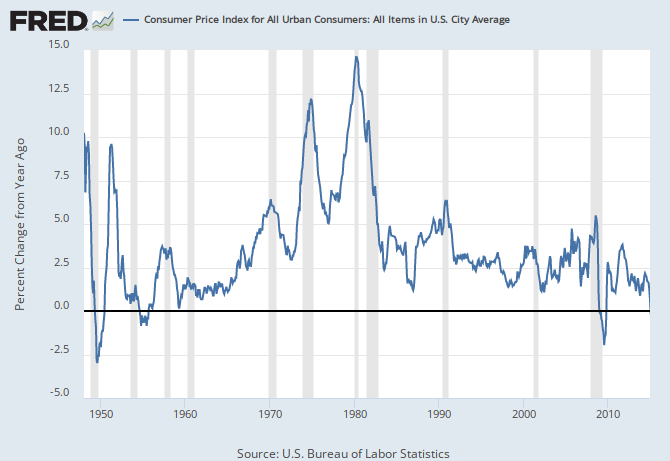 Is the Federal Reserve concerned that the CPI has dropped below 1%?
I wonder how much of this is due to falling oil prices. I suspect most of it. While it seems obvious that the drop in oil prices will put downward pressure on industrial prices (i.e. tubular steel, industrial/gray water, sand, synthetic oils, bentonite, diesel engines, etc), it doesn't seem obvious that it will affect consumer prices.
Perhaps the drop in the price of plastics, rubbers and other chemicals in consumer goods can account for this. However, demand should start to build as the CPI drops and as consumers save an extra $80 or so per month in gas money.
Monday, January 12, 2015
First Victim of the Oil Drop?
Maybe. WBH Energy was targeting the Barnett combo play which has NGLs - the Barnett is largely a tight gas formation. From Reuters:
Jan 7 (Reuters) - WBH Energy, one of many tiny shale oil and gas producers in Texas, has filed for bankruptcy protection, becoming what may be the first U.S. oil company to do so since crude prices started tumbling six months ago.
It listed assets and liabilities of $10 million to $50 million in its filing in U.S. Bankruptcy Court for the Western District of Texas on Sunday.
The company could not be reached for comment.
The privately held company, based in Austin, has leases in the Barnett Combo Play of the Fort Worth Basin, which mainly produces gas and is not a significant field in the current U.S. oil boom that has lifted output to the highest level in decades.
Two years ago, GMX Resources filed for bankruptcy protection. They later rebranded as Thunderbird Resources. This was somewhat of a shock to because GMX was a Williston Basin operator which is considered one of the stalwarts of the oil boom.
Saturday, January 10, 2015
Tuesday, January 6, 2015
A Tale of Two Oil Gluts
Consider this:
The 1980's drop in oil price was due to a supply glut created by the lowest cost producer.
The 2010's drop in oil price was due to a supply glut created by the highest cost producer.
I don't know if this is exactly true or not, but the general idea that Saudi and US production costs are at opposite ends is rather appealing and perhaps very true.
Sunday, December 21, 2014
Is Oil a Financial Thing?
In The Prize, Daniel Yergin laid out the argument that volatility (not high prices) of oil in the early 1980s was caused by financial speculation. The primary means of speculation was through derivatives. The NYMEX had then recently introduced future contracts and, according to Yergin, the story goes that guys like T. Boone Pickens made a small fortune off playing the volatility.
T. Boone had dabbled in cattle and cattle feed and so was well versed in futures trading. Flash forward 30-something years and we see a parabolic drop in oil prices. It is a straight line, so to speak, and reads more like a panic riddled sell-off (drop in demand) than a supply driven increase.
Commentary from Charles Hugh Smith's blog:
As I said before, the monetary base stops expanding and the Fed ends QE, all as oil prices begin their plunge. Still think the Fed will raise interest rates this coming summer? Does the Fed take the punch bowl away when the party is just getting started?Crowded trades (trades where almost everyone is on one side of the boat) unwind in precisely this sort of freefall. Once the trade has been unwound, however, the selling cascade exhausts itself and insiders who know better start buying. Buying begets buying, shorts start covering, and voila, a retrace that fills open gaps and kisses the 50-day moving average surprises everyone who was confident oil was heading straight down to $40/barrel.
More Pipeline Politics
In case you didn't have a FT subscription (don't ask why I have one):
Russia produces about as much natural gas as the US, which is about 6 times the amount Saudi Arabia produces. I recall, as a sophomore in college, reading The Prize and setting the book down to give thought to the fact that the majority of the world's oil and gas resources had been discovered before my father was born (1953). So, just how political is energy?
Tuesday, December 16, 2014
The Chart I Never Saw Coming
Need more time to figure this one out, but it does look very, very interesting.


Saturday, December 13, 2014
Out of Oil, Into Treasuries
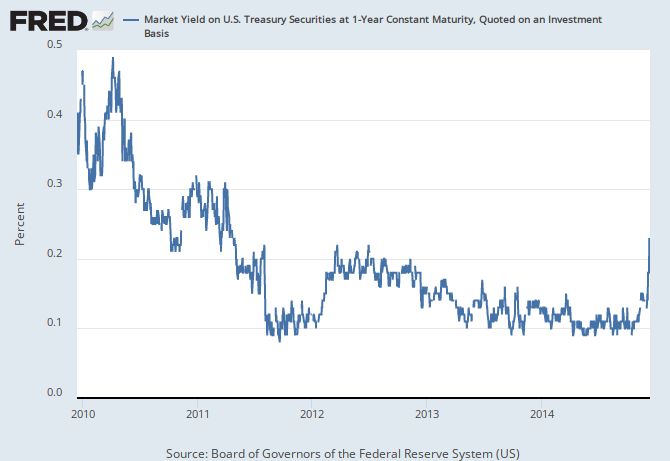
Where is the safe place for yield? Prior to the big drop in oil prices, it was just there - oil. After a 40% drop in prices over the past few months, investors need to look elsewhere. And what timing for them to go into US treasuries, if they so choose, as the Federal Reserves exits its third installment of Quantitative Easing and the stock markets begin to dip on weaker than expected consumer numbers.
Ladies and gentlemen, the Fed has left the building.

Ladies and gentlemen, the Fed has left the building.
Thursday, December 11, 2014
Where Does That Capex Go?
Reuters report, link via CNBC, with a headline saying that E&P spending could drop by as much as $150 billion in 2015. That is a lot of money. So who makes all this stuff for the oil and gas industry? All the pipes, rigs, pump, computers, compressors, ROVs, etc, where do they all come from?
Certainly oil exporting nations pay for capex to produce oil. But do Nigeria, Iran, Iraq, Libya, Saudi Arabia, etc produce the equipment they have installed in their fields? I wonder if countries like Sweden and South Korea won't take a hit from all of this.
Tuesday, December 9, 2014
Why The Drop In Oil Prices? Three Examinations
First: Libya? Libyan production skyrocketed by over 500,000 barrels per day from June to September of this year. Reached a peak of about 900,000 barrels per day. But now? There seems to be conflicting reports as to what is happening in Libya. It seems the rebels have taken over oilfields, but production will continue to come on line. Libyan production was at 900,000 bpd in September but now may be at 500,000.
Second: Supposedly Saudi Arabia has been offering lower prices for oil in US markets than in Asian markets. Nigeria, an OPEC member, has seen exports to the US dry up while Libya restarts exports to Europe. So there are some real reasons Saudi Arabia has to backtrack on its "US shale doesn't concern us" attitude it has promoted the past two years.
Third (put on your tin foil hat): The Federal Reserve (see explanation below)
Third (put on your tin foil hat): The Federal Reserve (see explanation below)
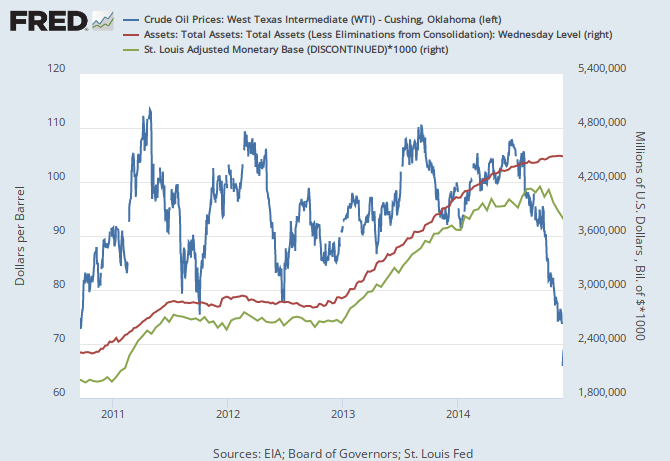
The monetary base stops expanding, so institutions with bets on rising oil prices begin selling. Eventually, the Fed announces the end to QE3 and weeks later the Saudis give the death knell with a "we're not finished, yet" response at OPEC.
Wednesday, December 3, 2014
Bring 'Em Out: Rise of the Consumer
So, I do not read Business Insider. Which is why I chose to use one of their headlines as a contrast for my thesis of rising consumer spending.
Black Friday sales plummeted this year, leaving retailers completely stumped.
After weeks of declining gas prices, many analysts predicted the biggest holiday season ever. Industry groups like the National Retail Federation reasoned that Americans would use their fuel savings on gifts.
Despite encouraging forecasts, Black Friday weekend sales were down 11%. Cyber Monday sales rose 8%, falling short of many predictions.
So where are the customers?
Where are the customers at? Where they at?
The Lord Purveyor of Future Obligations, His Royal Roll-Over of Timely Payment, Fortress of Accountability, Luke The Debtor saith: Buying higher ticket items.
That's just me. Maybe no one else feels that same way. But after 6 years of paying down debt, I wonder if this drop in oil prices is giving people the premature illusion of prosperity. But, the data are not in to show this. Where are the customers? It is time say Luke The Debtor...bring 'em out!
Tuesday, November 18, 2014

Saturday, November 15, 2014
Looking at The Data: Top Three & Next Three Oil Producers
It's cold this weekend. Very cold. The arctic blast, polar vortex, Rossby wave or whatever you want to call it, is acting up. So, I am staying inside.
For all the commotion in the media not geared toward the weather or Ferguson, there has been some attention spent on Saudi Arabia's offer of higher prices for Asian consumers and lower prices for others. This is all before the G-20 and the OPEC meetings this month. Maybe the Saudis want to remind everyone who is the alpha dog.
For all the commotion in the media not geared toward the weather or Ferguson, there has been some attention spent on Saudi Arabia's offer of higher prices for Asian consumers and lower prices for others. This is all before the G-20 and the OPEC meetings this month. Maybe the Saudis want to remind everyone who is the alpha dog.
However, the US, the largest consumer is, according to the EIA (biased?), the largest producer of oil. And its accent to number one has come within the past four years. This is must be a testament to American ingenuity, low-interest rate induced prices, and the inability to exit (escape) the exurban lifestyle.

Subscribe to:
Posts (Atom)