Tuesday, May 28, 2013

Rebound in Coal Based Electric Generation

From the EIA:
After an equal share of electric power was generated from coal and natural gas in April 2012, EIA's most recent preliminary data through March 2013 show coal has generated 40% or more of the nation's electricity each month since November 2012, with natural gas fueling about 25% of generation during the same period. 
Since May 2012, a combination of higher prices for natural gas and increased demand for electricity during the summer months led electric systems across much of the country to increase their use of coal-fired units. In March 2013, coal-fired units generated a little over 130,000 megawatthours of electricity, while natural gas units produced nearly 85,000 megawatthours.
Electric power generation by source, percent share.

Saturday, May 25, 2013

US Crude Oil Inventory: 30+ Year High

US crude oil inventory is at a three decade high.  From Barron's (a free preview):
There are a number of reasons for oil prices to fall: U.S. demand is slumping, Middle East output is steady, growth in China is slowing, and market prices are well above production costs for even the most expensive barrels. The Organization of the Petroleum Exporting Countries added to the bearish picture this month with a warning that global demand growth could slow this year.
The chart from the EIA's website of weekly crude inventory. 
US crude oil inventory.
The Barron's article also mentions that the S&P 500 and WTI oil have been in lock step.  I feel that for the past six months, the major indices have been on a tear while oil has remained rather stable, although the Brent-WTI spread is dropping. Similarly related, why did WTI oil (and the Nikkei 225) drop this past week?  I would lean toward recent release of Markit's Chinese manufacturing index, which shows weakening in Chinese manufacturing (thought here is still an expansion in stocks of finished goods).
S&P500/WTI oil price (spot) - past 5 years.

Tuesday, May 21, 2013

Egypt Credit Downgrade: CCC+

From the Financial Times:

The S&P report described Egypt’s outlook as “stable” because of the willingness of the international community to prop it up. Qatar recently committed to giving Egypt $3bn in financial aid. A $2bn Libyan deposit in the country’s central bank last month papered over the unhealthy state of its foreign currency reserves, which have dropped from $36bn at the start of Egyptian revolution to $14.4bn at the end of April.

Monday, May 20, 2013

Chinese Stimulus

Or not.  From Reuters (via Yahoo!):
"If there in an over-reliance on government-led and policy driven measures to stimulate growth, not only is this unsustainable, it would even create new problems and risks," Li was quoted by the paper as saying indirectly.
It is not a strong quote (indirectly?), but perhaps the politburo has come to terms with reducing domestic inflation in order to preserve wage competitiveness or at least reduce the rise in wages to preserve unemployment.

Might we see wave of government reform to address environmental issues?  I would think that such reform could lead the shift toward a stronger Chinese service sector and less reliance on export and more consumption of domestic production.

Here are a few other articles I have been reading lately:
Chinese NPLs (and another)
Chinese Foreign Exchange Rules
Hong Kong Dollar Peg
Hong Kong Yuan Peg

Wednesday, May 15, 2013

REITs

A few articles on REITs (Real Estate Investment Trusts). 

First, an article from Bloomberg discussing a few notable REITs, particularly American Capital Agency and its chief investment officer, Gary Kain. 
“Fannie Mae and Freddie Mac were not regulated by the markets,” Kain said. “That was a key complaint which turned out to be very fair. There weren’t any market forces that were controlling the government sponsored enterprises. They could borrow money irrespective of their risk posture because of the implied guarantee” of the government, he said.
Heard that before - do not necessarily agree.
The firms had “grown rapidly” by using low-cost, short-term financing to fund purchases of longer-term debt, he said.
Heard that before.  From earlier in the article.
REITs (BBREMTG) have been among the biggest winners from government policies to resuscitate housing and stimulate the economy. The Fed has made it easier and cheaper for the companies to borrow through the so-called repo market. The central bank’s buying has also pushed up the value of mortgage bonds that REITs invest in.
Second, an article from the Wall Street Journal.
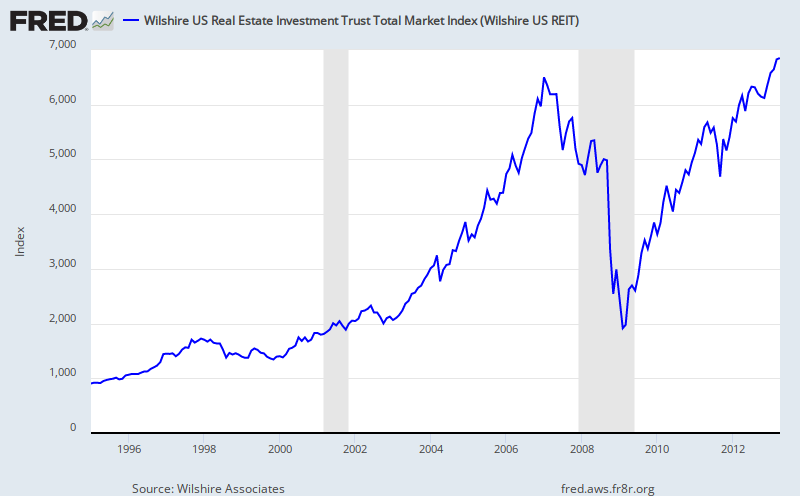
Mortgage REITs, which use short-term debt to buy longer-term mortgage securities, also are at the greatest risk if interest rates rise because that would increase their short-term borrowing costs and cut the value of the mortgage bonds that they hold, possibly resulting in losses and reduced dividends.
 The Wilshire REIT index.
Wilshire REIT Total Market Index.
And finally a recent CNBC (via Yahoo!) article:

Institutional investors are especially drawn to REITs because they provide not just earnings growth, but strong dividend growth. REITs are required to distribute at least 90 percent of taxable income to shareholders in the form of dividends. Also, real estate is relatively inexpensive right now. 
"Physical real estate is attracting institutional investors because there is a positive spread between how much it costs to finance real estate versus the income generated," added Goldfarb. 

Tuesday, May 14, 2013

Chinese Currency Speculation

Good post at Sober Look:

China's government allows exporters to buy yuan and sell dollars in order to convert their export proceeds back to domestic currency. But by exaggerating their exports (which are reported to understaffed and bureaucratic customs officials - and not the National Bureau of Statistics ) these firms are allowed to buy larger amounts of CNY than they need - effectively taking a bet on the currency. The more they claim they exported the more CNY they can buy. As CNY appreciates, they make money. Normally China would not allow currency speculation, but these folks have found a loophole that lets them go long CNY against USD. The unintended consequence of the FX speculation is a bloated national export number.
Interesting idea considering how commodity stockpiles are growing larger in China, and that those stockpiles can be used as collateral to roll-over loans (much like using home equity to refinance a mortgage).  I find myself asking: who benefits from this trade: the dollar seekers or the yuan seekers?

OPEC Meeting

OPEC will have an official meeting later this month, on the 31st in Vienna, Austria.  OPEC is keen on the possibilities of a Chinese and Eurozone recession affecting demand, as well as the rise in US production and the debate over the XL-Pipeline affecting supply.  Member nations Libya and Iraq are still expected to request quota increases, and Iran and UAE are expected to be the most opposed.

As far as prices?  There is not a whole lot of news about prices.  However, I remain agnostic.  Given the general language from the OPEC countries (notably Iraq, Iran and UAE), there does appear to be some squabbling going on that indicates production will go up in Iraq and Libya.

So for a country like Saudi Arabia, which is seen as holding the most control over prices because they can  make the largest reduction in volume, the supply and demand balance will have a big impact on government revenue.  So consider the production and consumption amongst some of these OPEC nations over the past several years.